By Robert Montgomery and Davey Heller

“Louis Bonaparte appears as the incarnation of the political mediocrity, the opportunist, the rogue, who, having played the part of a player and adventurer, returns to seize power and crown himself emperor. He is the man of the hour, the man of circumstance, and yet the man of illusion.” – The Class Struggles in France, Marx 1850
Marx’s description of Louis Bonaparte could just as easily apply to Donald Trump. Just as Marx condemned rentiers, stock-jobbers, and bankers who subsist on the wealth of others rather than on manufacturing or productive labor, today’s billionaire elite relies on finance, real estate, leveraged buyouts, financialization, asset bubbles, and derivative wealth rather than on investment in real production.
The odious Trump is no aberration. If he were gone tomorrow how much of real significance would change? This is like asking if Hitler had not existed would there still have been fascism in Germany. In order to understand Trump we need to look beneath the monstrous physiognomy and the endless spectacle of his regime. We need to see the underlying social forces that he represents. Equally important, is to recognize the broader historical and material conditions that have allowed such a grotesque figure to rise to prominence.
The top 0.1 percent make their move
We are living through the greatest concentration of wealth in modern history in the United States. The richest one percent now control an astonishing $49 trillion, approximately one-third of all wealth. Just seven tech giants—Apple, Microsoft, Amazon, Google, Meta, Nvidia, and Tesla—now make up one-third of the entire S&P 500. Despite their slowing profits these companies alone have accounted for more than half of the stock market’s gains over the past two years. The tech owners dominate the media spectrum and information space. They are subsidized by the Pentagon and are major contractors to the CIA.
At the center of this oligarchy is a small circle of tech billionaires — Elon Musk, Peter Thiel, David Sacks, Marc Andreessen, and Larry Ellison — who have tied themselves openly to the far right and now lead key assaults on democratic institutions. Such an unparalleled concentration of personal wealth by the top .1% represents the apex of explosive levels of social inequality which cannot be reconciled with the preservation of democratic rights. Their wealth is both a symbol and an instrument of a system in which economic power has become detached from any democratic accountability.
The richest 1% of households in the United States have accumulated almost 1,000 times more wealth than the poorest 20% over the last three and a half decades, and economic inequality is getting worse at a rapid pace.
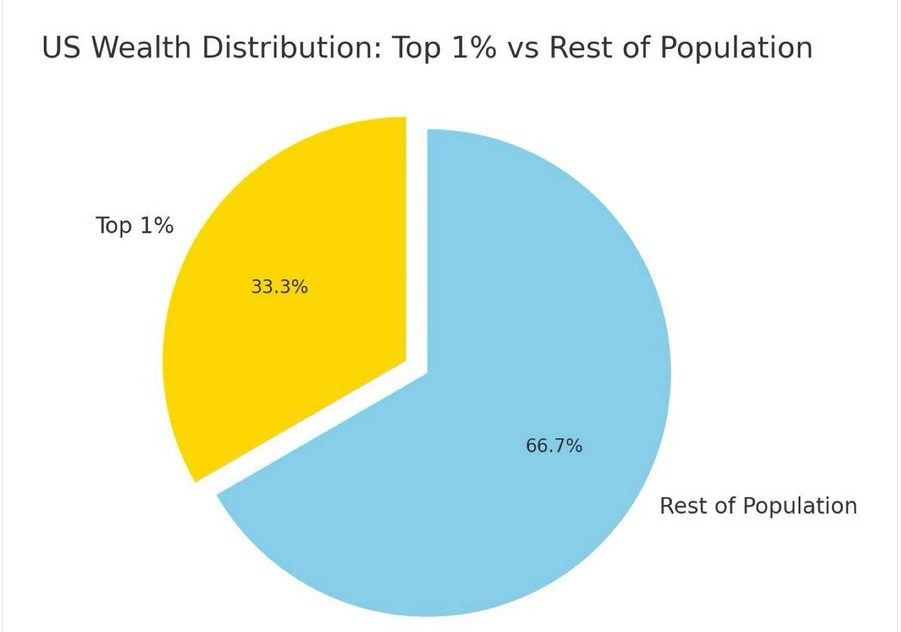
Over the past year alone the wealth of the 10 richest U.S. billionaires soared by $698 billion. That means that the top 0.1%’s share of total wealth is now at a record high of 12.6%. The top 1% of earners control more than 1/5 of all income while the bottom 20% of Americans share just 3.1% of total income.
Trump is leading a government of the most parasitic layers of American finance capital. The circle of billionaire oligarchs tapped for the Trump administration is worth four thousand times more than the previous Biden cabinet. At $383 billion this club holds more wealth than the combined gross product of 172 countries. Elon Musk, the world’s richest man, helped oversee the slashing of $1 trillion from the state budget by mass firing of federal workers, outlawing their collective bargaining rights, gutting essential social insurance benefits, and destroying entire government departments. The Trump regime is a billionaire oligarchy masquerading as a government.
Deindustrialization
During the Golden of American capitalism (1945-70) the US was the world leader in ship building, manufacturing, and in mining industrial minerals:
- By 2025, American shipyards no longer build oceangoing merchant vessels, only small ships and warships.
- Machine tools make the machinery needed for almost every industrial — process. Now just three firms now remain of the old giants of machining.
- Tungsten, a critical mineral needed for everything from jet engines to x-ray tubes, is not being mined in the US. Over 100 deposits are not being used currently . Trump’s recent concession to China on tariffs was driven by the need to get tungsten for defense production.
The 2008 financial crisis marked the end of the long process of the deindustrialization of the United States. In the recession years after the Wall Street crash the centers of rubber, steel, automobile, metallurgy, and food processing production of the Midwest were transmuted seemingly overnight, into a landscape of rusting mills, collapsing town centers, and industrial carcasses.
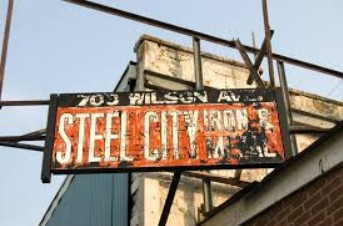
What had once been dense concentrations of productive labor and high-wage employment were suddenly stripped of their economic foundation. Steel complexes, auto plants, machine-tool shops, and chemical facilities—the material infrastructure of U.S. industrial hegemony—were abandoned by finance capital.
Storied working class cities like Pittsburgh, Buffalo, Cleveland, Gary, Detroit, Milwaukee, homes to stable working-class communities, were suddenly surrounded by shuttered mills, gutted plants, and rusting machinery left behind like the discarded carcasses of financialized capitalism.
Swathes of Ohio, West Virginia, Pennsylvania, Kentucky, rural/small-town New York, parts of Michigan and Indiana were among the hardest-hit by the opioid epidemic and for the rise in “deaths of despair” ( suicide, alcoholism, drug overdose) in the wake of the financial crisis.
Left to its own devices, capitalism responds to market crashes by letting the less profitable firms go under in order to restore the rate of profit before beginning a new upturn. But rather than allowing the system to liquidate its dead capital through a depression, the state stepped in to keep the system on life support. Obama spent $8 trillion to bail out the banks and financial markets and rescue the auto companies. “Wall Street got bailed out and Main Street got shut out” as the slogan went.
As the recession worsened and Obama offered nothing but more misery, the liberal Democrats expanded the wars in Iraq and Afghanistan, launched new regime-change wars in Libya and Syria, while instigating a coup in Ukraine. Lower-middle-class and working-class people felt increasingly betrayed by the Democrats. In 2016 large sections of the working-class electorate, responding to Trump’s promises of reindustrialization and national revival, shifted their allegiance to the Republican Party. In the last two election cycles the Rust Belt working class has remained a decisive factor in U.S. presidential politics.
The rate of profit has not truly recovered to pre-recession levels. Corporate profits are rising in absolute terms, but the rate of return is too weak to generate sustained investment in real production. Roughly sixty percent of all corporate profits now flow straight into financial markets, feeding speculation rather than industry. Fictitious capital is driving capital accumulation, siphoning resources from production, and suppressing new investment more aggressively than at any point in the past half-century.
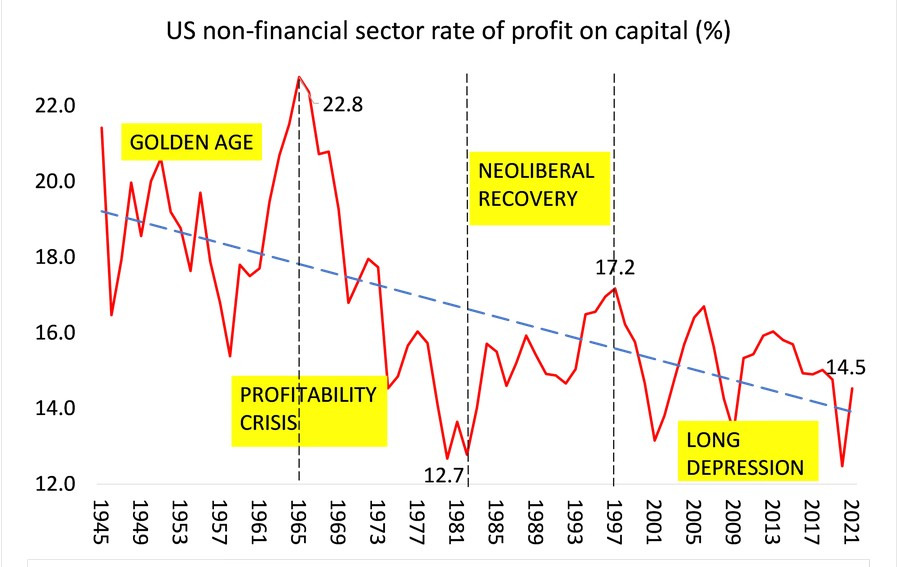
To prop up inflated asset valuations under conditions of stagnation and declining profitability, finance capital demands heighter rates of surplus extraction from the working class. It is this imperative that underlies a renewed offensive against the social gains secured in earlier periods: the dismantling of public services, the destruction of trade unions, and driving real wages toward subsistence levels. This is the real purpose behind Musk’s efforts inside the federal government: to clear the way for deeper cuts, more privatization, and a society run entirely for the benefit of the rich.
At the same time as profitability sinks, the organic composition of capital is rising, accelerated by AI-driven automation. Ever fewer workers are needed to operate ever larger, more complex means of production. Capital must extract more surplus from a shrinking base of labor power, which exerts more pressure on profit rates.
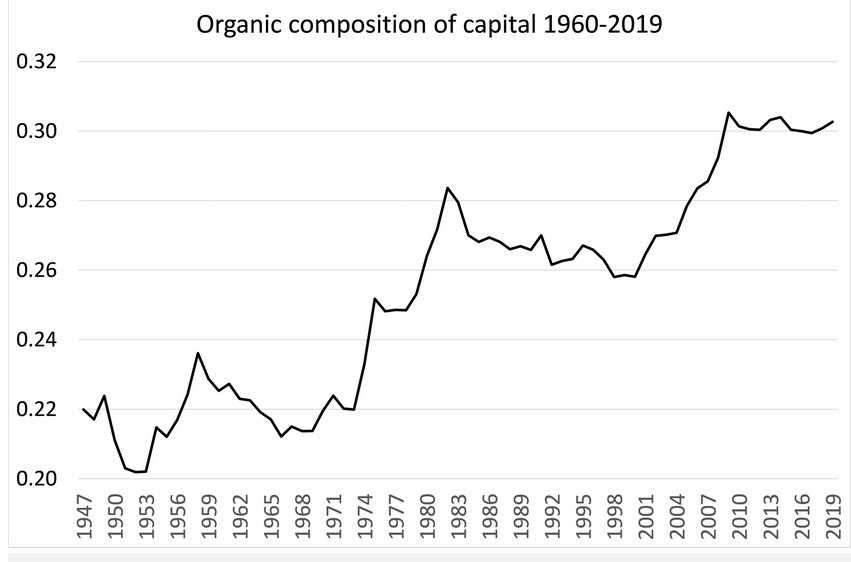
With profitability weak and growth sluggish, the system’s capacity to absorb democratic demands has sharply narrowed. The result is a growing contradiction between the requirements of capital accumulation and the institutional norms of liberal-democratic governance.
Behind all this lies a deeper problem: the world economy is slowing down, and global profit rates are falling. When that happens monopoly capital responds by going on the offensive against its capitalist competitors, its own working class, and against the dominated countries of the Global South. Imperialist finance capital (The ultra-wealthy and the corporations they control) want to claw back every gain workers have made. They push to tear down public services, break unions, and drive wages down to poverty levels.
However, there is a major complication for imperialism to launch this offensive on a world scale: The hegemonic challenge posed by China with its booming mix of state controlled and capitalist enterprises under the direction of the Communist Party of China. Whilst the cheap labor of China was a key factor that facilitated the US ruling class to implement the twin policies of neoliberal deindustrialisation and financialisation. The planned economy of China enabled it to actually utilise the surplus value created within China to break out of its designated role within the imperialist world market. And this created a massive economic blowback effect on the West.
In just twenty five years China has become the largest trading partner for 150 of the 193 states in the world. More than half of all economies now trade twice as much with China compared to the United States. China’s current trade surplus tops a trillion dollars. It is not just the quantity of trade but the quality of that trade that threatens imperialist finance. China now dominates trade in exactly those key economic areas that have declined in the US due to deindustrialisation such as ship building, strategic minerals and machine tools. China is no longer just a cheap labor source but a real competitor.
This massive growth in China’s trade with the world now provides an alternative source of trade, loans and investment for the countries of the Global South in particular. This blunts the attempt of the US to use the club of neo-colonial economic tactics it has relied on since World War 2 to attempt to reverse its half century of declining profitability
Of course the US will try to counter China through increasingly reckless military interventions and regime change operations but even in the military field, the US knows its days of dominance are not indefinite. This is adding to its sense of frenzy. Perhaps there are echoes of how sections of the imperialist powers in Europe and Asia turned to fascism in the 1930’s as their economies and profits shrank and the Soviet Union’s economy continued to grow.
Hostility to communist China animates all sections of MAGA from Trump to Tucker Carlson feeding the anti-communist fury that lies at the heart of all fascist movements.
Pete Hegseth, a self-proclaimed Christian crusader and U.S. Secretary of War, has openly declared that the United States is preparing for war with Communist China. In a 2020 book steeped in apocalyptic rhetoric, Hegseth frames U.S. foreign policy as a “holy war” against the left, China, and Islam, casting the Chinese as “the villains of our generation” and warning that failure to confront Communist China now will leave Americans someday forced to “stand for the Chinese anthem.”
The investigation launched by the House Republicans into whether the peace group Code Pink is funded by the Communist Party of China can be expected to be only the beginning of the attempts to link opponents of the Trump regime to China.
Whilst much of this anticommunism is not confined to MAGA alone; it unites the U.S. ruling class as a whole. On November 21, 86 Democrats joined Republicans in the House of Representatives to overwhelmingly pass a resolution condemning the so-called “horrors of socialism.”
Fascism and Capitalism in Crisis
Historically, when the material conditions needed for social stability become fundamentally incompatible with even a modestly independent workers movement, the ruling class has turned to fascism as in Germany.
20th century fascism was a regime defined by extreme crisis and sharp class tensions, the product of prolonged economic stagnation. The margin for negotiation between the working class and the bourgeoisie had nearly disappeared, leaving the capitalist system incompatible with any vestige of an independent working-class movement.
In our own time a parallel dynamic is emerging, though it takes different forms. During the Great Depression, despite a decade of deep stagnation, American capitalism still possessed vast reserves of unused productive capacity. Those reserves made New Deal stabilization and reforms possible.
However, the situation today is different. Decades of deindustrialization, financialization, and wage stagnation have eroded the economic base that once underpinned reform. The result is a growing contradiction between the requirements of capital accumulation and the institutional norms of liberal-democratic governance.
Trump is trying to consolidate a fascist regime by means of a presidential dictatorship. He has not yet succeeded. To do that he needs to overturn the constitutional order and impose a repressive police state on a polarized, still democratic population. Before he gets to that point it’s necessary to first break up the existing liberal democratic state. He needs a battering ram.
Since the attempted coup of January 6, 2021, Classconscious.org , basing ourselves on Trotsky’s Germany writings, has characterized MAGA as a fascist movement. Among Marxists this is a minority view. Most see Trump as some form of Bonapartism. Some even see MAGA as a distorted reflection of working class anger and misplaced resistance. Nathaniel Flakin, writing in Left Voice, paraphrases the standard Trotskyist argument: “… if we are already living under fascism, it means that all workers’ organizations have become fascist as well.”
Responding to this same stock axiom, Marxist economist Ernest Mandel wrote: “one hears today that only when the trade unions have been totally smashed and criminalized can we seriously talk about fascism. This is a lazy formula that disarms the left and the workers movement. It ignores the concrete social reality of capitalism in what is perhaps its deepest global crisis in history”. And this is as true today as it was when he wrote it.
While its class content remains constant, fascism takes different forms at different times and places. We do ourselves a disservice when we treat a form of capitalist class rule as fixed and unchanging for all times.
MAGA theorists
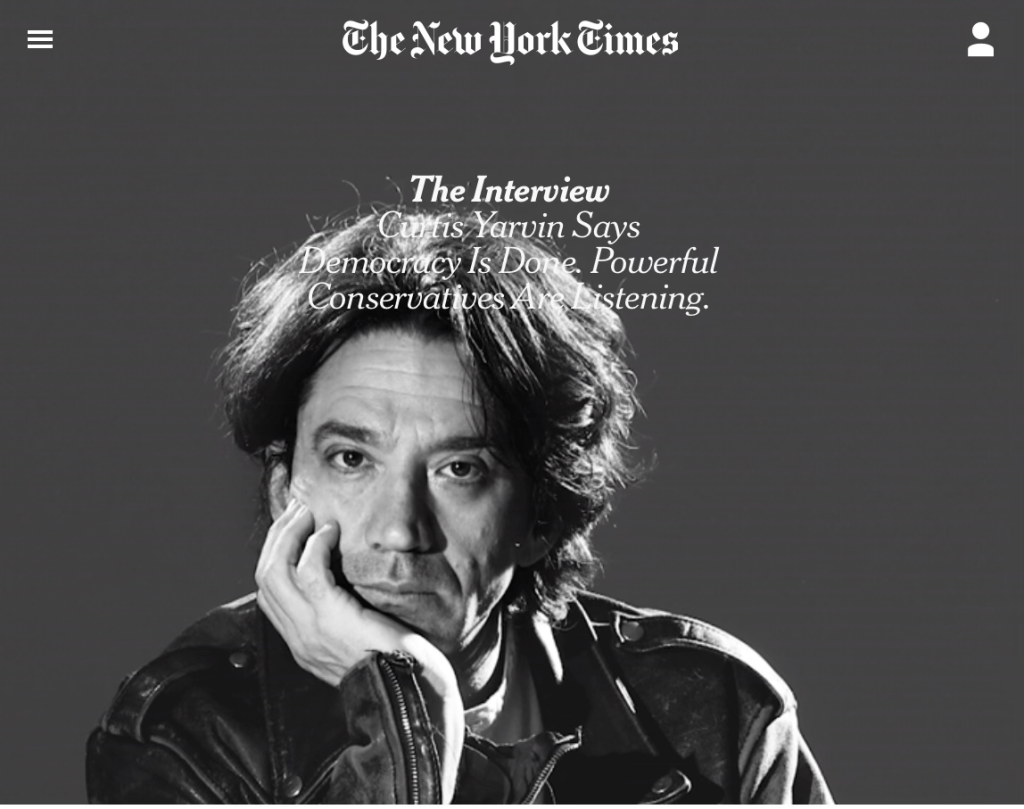
Curtis Yarvin, Dark Enlightenment philosopher, proposes that the government be structured as a corporation with a CEO-monarch wielding absolute authority. Peter Thiel, founder of PayPal and patron of Vice President JD Vance, echoing his philosophical mentor writes:
“Most importantly, I no longer believe that freedom and democracy are compatible.”
Trump influencer Steve Bannon is the ideological bridge between the anti-elite, nationalist lower middle class of MAGA and its billionaire patrons. Bannon works to ensure elite dominance in the alliance while giving the base the illusion of power in the culture war. And it’s Bannon who is the ideologue of “deconstructing the administrative state”.
In a 2024 interview Bannon, identifying himself directly with the Heritage Foundation, spelled out the state deconstruction in explicit terms:
“Project 2025 and others are working to immediately focus on immigration, the “forever wars”, and the tax and finance. And simultaneously on deconstructing the administrative state and going after the complete and total destruction of the deep state. In the first 100 days — this is going to be different from 2016 — we will have 3,000 political appointees ready to go” (David Brooks, My Unsettling Interview with Steve Bannon, The New York Times, July 1, 2024).
The fascist ideological assault on the internal “administrative state” is closely linked to the external fight against Communist China. John Bellamy Foster, alluding to the neo-McCarthyite obsession with destroying “cultural Marxism,” points to Christopher Rufo. Rufo is a former fellow at the Heritage Foundation and the Claremont Institute and is the author of, America’s Cultural Revolution: How the Radical Left Conquered Everything. Rufo has popularized the idea that CRT, DEI initiatives, and “transgender ideology” are all products of “cultural Marxism.”
In the absence of any real Marxist presence in the United States, the term “cultural Marxism” functions as an all purpose stand-in. It is used to justify the cleansing of media outlets and universities of all left-wing and progressive ideas. At the same time, the bogeyman of “cultural Marxism,” reinforces the portrayal of communism as the central enemy of the United States. At its core fascism is anti-communist.
MAGA: a fascist movement resting on the lower middle class
In a recent article, “The MAGA Ideology and the Trump Regime”, Monthly Review editor, John Bellamy Foster has made a major contribution to the understanding of MAGA as a fascist movement.
Bellamy Foster clarifies the definition of fascism by returning to a class based, materialist analysis as opposed to the common ideological or personality-driven definition. When mainstream figures like Biden or Harris say, “Trump is a fascist,” what they mean is that he is an authoritarian personality who seeks to concentrate political power in his own hands. This is essentially a description of an individual’s behavior or style — an ideal-type, not a class analysis. Bellamy Foster reckons that this misses the point. The MAGA base is neither a reflection of Trump nor predominantly working class in composition. Rather it is predominantly a lower-middle-class phenomenon. As for historical fascism:
“Fascism is a particular political movement/state form within capitalism opposed to liberal democracy. It arises when the capitalist class and its state are in structural crisis. The object of the fascist movement is to annihilate the liberal democratic state through a process of ensuring that the various institutions of the state and civil society fall into line with the requirements of the fascist/neofascist requirements.”
The lower middle class (LMC) is a strata of the petit bourgeoisie: small proprietors, minor managers, and rural or suburban property holders. Its economic base is narrow and perpetually threatened by competition, debt, and creeping proletarianization. This stratum has long been disproportionately white, has supplied some of the most nationalist, militaristic, and authoritarian political tendencies, and is often fused with evangelical fundamentalism.
The ideology of this class fraction is shaped by a chronic fear of downward mobility and resentment toward “elites” imagined as eroding its fragile autonomy, status, and property. Positioned between the capitalist class and the working class, it carries its own contradictory consciousness: on the one hand, dependent on the reproduction of stable capitalist social relations; on the other hand anxious, about its own vulnerability to shifting market forces. Its resentments tend to focus not on the billionaires whose lifestyles it can only imagine, but on the strata immediately above it.
Just above it sits the upper middle class or the professional–managerial class (PMC), whose function is to administer both capital and the state. In right-wing ideology the PMC is collapsed into a single, unified enemy. It is imagined as an entrenched bureaucracy extending through government agencies, public television and radio, public schools, universities, nonprofits, cultural institutions, and the mass media.
The PMC is depicted as under siege from both directions—pressed by capital from above and by the masses from below. Within this narrative, it becomes less a class with a specific economic function than a parasitic cultural elite: self-appointed arbiters of values, language, and legitimacy. The result is a moralized class enemy, blamed not for its role in managing exploitation but for allegedly corrupting the nation’s culture.
This caricatured formation also absorbs “entitled” people of color, DEI infrastructures, and the urban poor, all seen as beneficiaries of a liberal state and hostile to “ordinary” people (read: lower-middle-class white) people. This fetishized antagonist allows petty-bourgeois grievances to be displaced from capital onto a cultural and bureaucratic elite. They view Musk and Bezos as business innovators and models for self employed contractors. The working class represents unions, higher taxes, regulations, and blue cities.
Obama’s presidency compounded these resentments. The bank bailouts, auto rescue, and health-care reform looked like the state protecting Wall Street, unionized workers, and people of color—everyone except the small proprietors and contractors who felt themselves slipping. When “recovery” meant years of precarious jobs, rising debt, and shuttered businesses, many came to believe they were being left behind. Their resentments deepened into a reactionary political formation aimed not at the capitalist class but at the state, and at those groups believed to benefit from staye interventions. This was a classic petty-bourgeois revolt: a class squeezed from above and threatened from below, directing its anger not at capital but at a demonized cultural and bureaucratic elite.
The working class does not own productive property. They own neither businesses nor rental property. The working class is multiracial, concentrated in urban or metro areas, employed in manufacturing, logistics, hospitals and hotels. It is located mostly in unionized sectors such as federal public employment, auto, steel, and other industrial or service-union strongholds.
Bellamy Foster sees the Tea Party insurgency that emerged in the wake of the financial collapse of 2008 as the political root of MAGA. The Tea Party galvanized rust belt resentment into political action. Organizing around a libertarian anti-tax, anti-elite, anti-immigrant, and anti-government program, Tea Party Republicans began the transformation of the Republican Party into today’s neofascist party of MAGA. Tea Party mascot, “Joe the Plumber,” became the archetype of the lower-middle-class, right-wing populism which prefigured MAGA.
So the class composition of MAGA is quite different from the actual U.S. working class, and recognizing that difference is central to any materialist analysis of its authoritarian politics.
By rough estimate about 1/3rd of all Republican Party voters are core MAGA. This bloc represents the precarious petit bourgeoisie, and those sections of the working class most impacted by the globalization of production. There is the usual rabble of far right xenophobes and white nationalist racists. A third influential bloc is evangelical Christians.
The ranks of the January 6th coup attempt were for the most part small scale merchant layers, retired and off duty police and military personnel, and members of fascist militias like the Proud Boys and The Oathkeepers. Ashley Babbitt, killed by the FBI as she breached the Congressional chambers, was a 14 year Air Force veteran of two wars, a security guard at a nuclear power plant, an indebted small business owner, and a follower of the far right QAnon conspiracy group.
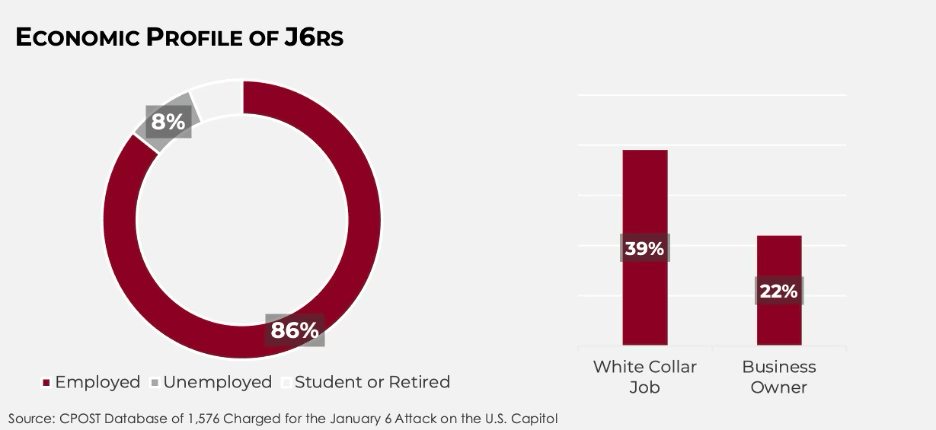
Trotsky described this mob well: “Through the fascist agency, capitalism sets in motion the masses of the crazed petty bourgeoisie and the bands of declassed and demoralized lumpenproletariat – all the countless human beings whom finance capital itself has brought to desperation and frenzy.”
Bellamy Foster underscores that the lower middle class/monopoly capital alliance is intrinsically unstable, and its contradictions are so deep that the bloc cannot endure for long in its current form:
a. MAGA expected lower prices— got Trump’s tariffs which increased prices an estimated $1,200 per household per year.
b. Expected reduced taxes— got massive tax cuts for elite billionaires
c. To break dependency on the welfare state— got its own entitlements cut that keep the LMC afloat
d. Trump to end the forever wars— got new military confrontations— bombing Iran, more proxy war in Ukraine, Drone murders in the Caribbean
e. America First nationalism— got expanded Globalization
f. Expected protection of domestic industry and reshoring production— got more globalism. National chauvinists cannot control a capitalist class tied to globalization.
g. MAGA Paranoia— got the Surveillance State
MAGA is suspicious of the surveillance state while Tech capital is heavily invested in AI, data mining, and surveillance infrastructures.
The billionaire class demands an ever-larger transfer of income upward from the entire population, including MAGA households.
MAGA increasingly resembles the left wing of the Nazi movement (the Strasser faction):
- Mobilized as a shock force against labor, the welfare state, and democratic institutions;
- disposable once monopoly capital no longer needs them.
Ultimately MAGA will share the fate of the Strasser wing of the Nazi movement in Germany. Having done their job as a batting ram for big capital they will be thrown aside. They will be precipitated into the working class or the lumpen proletariat
MAGA after Trump?
“The historic left is in total collapse. They always focus on the noise, never on the signal. They don’t understand that the MAGA movement, as it gains momentum and develops, is moving much further to the right than President Trump. They will look back fondly on Donald Trump. They will ask: Where is Trump when we need him?” Steve Bannon to David Brooks
MAGA is a political movement of the lower middle class that rode in on Trump‘s wings but its fate does not depend on him. Trump was a wrecking ball who smashed the liberal state. If Trump was destructive, then JD Vance represents an attempt to erect a post-liberal project. Vance is an America First chauvinist, native Appalachian, ultra-Catholic traditionalist like Bannon, and a Peter Thiel product— perfectly positioned to bridge MAGA resentment and elite rule.
Trump‘s collusion with Israel in the attack on Iran, the scandal over his refusal to release the Epstein files, and the assassination of Charlie Kirk in September, have combined to cause a deep crisis in the MAGA movement. The fault line divides America First isolationists like Tucker Carlson, Candace Owens and Nick Fuentes from Zionist globalists like Ben Shapiro and Lori Loomer. This is a reflection of the underlying class contradictions in the alliance. When the fascist movement assembled last week in Phoenix, JD Vance emerged as a full throated white Christian nationalist calling for unity in the fascist movement. Turning Point USA leader Ericka Kirk anointed Vance as the heir of Trump.

As the fascist movement identifies itself explicitly as Christian nationalist it will likely shift its center of mass to the American south, and less to the swing states of the upper Midwest like Michigan, Wisconsin and Pennsylvania. Its organizing base will be the semi-rural, petit-bourgeois agglomerations of the Sunbelt. There are historical and social reasons for this which will be the subject of a future article .
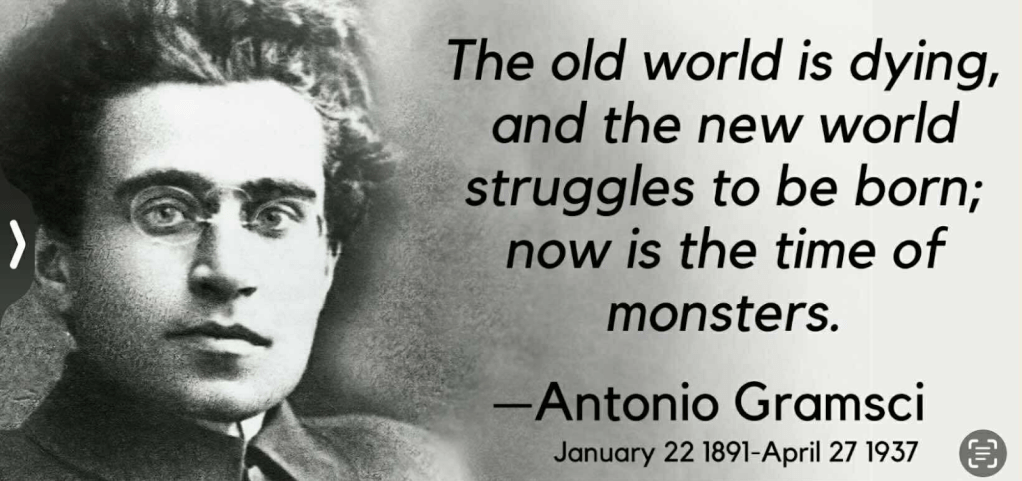
For the entire postwar era we have lived under liberal capitalism. Liberalism is a form of political rule that works when capitalism is growing and able to tolerate concessions. Postwar liberalism has been a “rules based order”, a set of social norms like trade union rights, civil rights, legal equality, checks and balances, and political pluralism.
In the interregnum the old norms of class rule have lost their legitimacy, and no longer command popular consent, but they have not yet been replaced by a new form of post-liberal rule. And it must be stressed that the crisis can’t be viewed only through a national lens, but it is refracted nationally.
A presidential dictatorship relying on police agencies like ICE, Homeland Security and Border Patrol is in place, but fascism has yet to be consolidated. Twice in the last six months tens of millions of people have mobilized against the Trump regime in No Kings Day protests. The political terrain is contested.
Bibliography
Hedges, Chris. American Fascists: The Christian Right and the War on America. New York: Free Press, 2007.
Field, Laura K. Furious Minds: The Making of the MAGA New Right. Princeton, NJ: Princeton University Press, 2025.
Foster, John Bellamy. “The MAGA Ideology and the Trump Regime.” Monthly Review 76, no. 1 (May 2025).
Foster, John Bellamy, and Zhao Dingqi. “Deciphering the MAGA Ideology: An Interview with John Bellamy Foster.” Monthly Review, August 2025.
Parrott, Sharon. “Well, That Was Quick: Trump’s Total Betrayal of Working People Is Now Complete.” Common Dreams, February 2025.
“How Did We Get Here? The Threat of Fascism in the US.” Class Conscious, June 2020. https://classconscious.org.
“‘Imperialism and the Development Myth’: An Important Defence of Lenin—but Is Chinese Development Really So Limited?” Class Conscious, May 2024. https://classconscious.org.
 Class Conscious