by Karin Hilpisch 10/3/2025
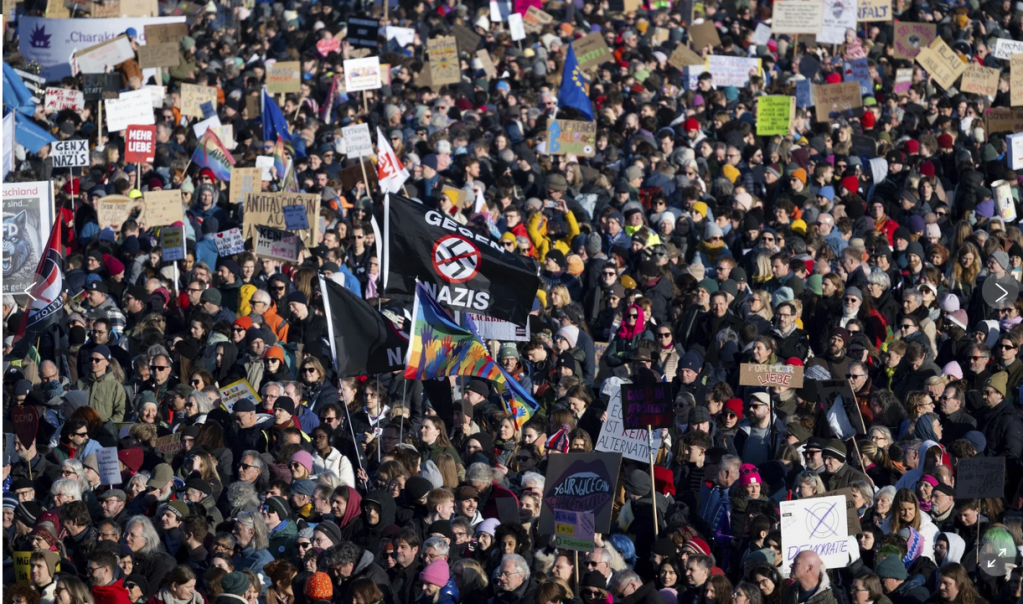
In the 2025 German federal election, the AfD (Altaernative for Germany) won more than 20 perCent of the votes, almost doubling their result in the federal election in 2021, and is now, for the first time, the second strongest force in the Bundestag (Federal Parliament), second in line to the CDU (Christian-Democratic Union). This occurs after mass street protests took place in several German cities, partly under the slogan of an opposition to a broad shift to the right but always focusing on the AfD, claiming to build a “firewall“ against fascism. When chancellor-designate Friedrich Merz gets criticized for having crushed said firewall by making parliamentary common cause with the AfD against immigrants, or more precisely, against full citizenship rights for all immigrants, it should be noted that, when it comes to racist scapegoating, especially demagogy against refugees, there is a considerable overlap between the programs of AfD and CDU/CSU (Christian-Social Union, in Bavaria).
To characterize the AfD, the terms far-right, extreme right-wing, fascistic, fascist are being used interchangeably, but those concepts do not have an identical meaning. E.g., unlike the Nazis, the AfD does not command paramilitary shock troops in the streets to terrorize workers. Nonetheless, some Trotskyist groups in Germany are calling for a united front (UF), i.e., common action of revolutionists with reformist/ bourgeois workers organizations as defined by Lenin, against the AfD. If a significant parliamentary force can aptly be characterized as fascist, judging by its program, should the case be made for a UF? It seems not, considering Trotskyists’ numerically relatively low significance in Germany, if we heed Trotsky’s point that,
“Where the Communist Party is as yet only an organization of an insignificant minority, the question of its attitude towards the united mass front can be of no great importance or any practical organizational significance” (1).
Moreover, who takes the reformist part in a UF? Historically, it is the trade unions and the social democrats; however, whether the concept of a bourgeois workers party applies to today’s SPD (Social Democratic Party of Germany) or PDL (Partei Die Linke/ Left Party) strikes me as at least debatable. Partly constitutive of reformist workers organizations is systematic class collaboration with bourgeois forces, and a cleavage between program and policies when in power, the latter always being more reactionary than the former. In this respect, the BSW (Sahra Wagenknecht Alliance), which originated last year as a split from The PDL, qualifies even less as a member of the club, given that their program is itself pretty reactionary on the issues of refugees and the right of asylum.
The SPD is co-funding and politically backing Israel’s genocide in Gaza, the PDL performs likewise as a steadfast defender of Israel’s “right to self-defence” as exercised by bombing children; that they do so at times inconsistently is no saving grace but adds massively to the disorientation of the working class. As the WSWS points out, “pursuing right-wing capitalist policies in the name of a ‘left’ party is creating the political frustration that the AfD fascists can exploit” (2).
It is not against this backdrop only that the question arises whether these social-democratic parties can still aptly be referred to as workers parties in any meaningful sense. If the answer to this question is no, it follows that SPD, PDL, and BSW are merely bourgeois parties, albeit possibly more progressive than CDU/CSU in certain respects, and UF appeals to them make no sense for revolutionists, amounting to calling, in effect, for a popular front. Appeals to more progressive agents of the ruling class to join forces with workers against more reactionary ones block independent working class action, the surest recipe for further strengthening the fascists. Popular fronts function, to quote the WSWS again, to “misdirect revolutionary energy into dead-end appeals to the bourgeois state, preventing workers from developing their own independent political movement” (3), to disarm the working class.
When political parties in power adopt policies which are more reactionary than their program, this tends to generate popular support for parties with a reactionary program that matches those policies. And the more the former is the case, the more the latter is likely the consequence. The reformist program-policy cleavage functions to channel, i.e., neutralize and paralyze, workers’ mobilization in class struggle. This dynamic occurs indispensably as a principle of operation of the capitalist system, serving the shared interest of its agents in the preservation of bourgeois power.
The capitalist system is based on the political division of labor, as it were, between all parliamentary parties in the service of maintaining bourgeois power. That is, the parties fulfill different functions and at the same time stand in a relationship of interdependence. The logic of the lesser evil which is to be preferred over a greater one, is not applicable when both are two sides of one and the same evil, among other things, the fundamentally racist bourgeois consensus. Or in Trotsky’s words, the parties are all
“component parts of one and the same system. The question as to which one of them is the ‘lesser evil’ has no sense, for the system we are fighting against needs all these elements” (4).
A repressive asylum and immigration policy is an essential instrument for dividing and thus demobilizing the working class. The ‘division of labor’ here is that far right parties such as the AfD represent the anti-asylum program which is implemented by liberal parties with laws to tighten or de facto abolish the right of asylum.
The allocation of program and policy to different agents obscures their being two sides of the same coin, thereby dividing and disorienting the resistance against either. The racist program of the AfD distracts from the racist policies of the so-called Traffic light coalition (SPD, Green Party, Free Democratic Party), resulting in anti-AfD protests in alliance with the SPD, making it pointless for lefttist groups to stress that the protests should be directed not only against the AfD, but also against the government. After all, these protests function precisely as a kind of ‘lightening rod’, to divert social anger away from the government, giving it cover, and they do so objectively, i.e. irrespective of the subjective motives of those involved.
The pseudo-consensus of opposition to the AfD agenda also distracts from the German government’s involvement in the Gaza genocide, as manifests clearly in the hostility, shown at some anti-AfD demos, toward expressions of solidarity with Palestine.
The bottom line is, organizing and supporting anti-AfD protests amounts to popular frontism, in my view, i.e., an alliance of bourgeois and proletarian forces against a supposedly common enemy, obscuring the anti-working class agenda of the government. This does not mean, however, that revolutionists are called upon to ignore popular front demos, simply to stay away from them. We can, rather, attend them with our own slogans and propaganda material, using them as an opportunity for political education and agitation.
(1) Leon Trotsky, On the United Front (March 1922)
(2)WSWS: The reactionary role of Germany’s Left Party in the fight against fascism and war
(3) Ibid.
(4) Leon Trotsky, For a Workers’ United Front Against Fascism (December 1931)
 Class Conscious