Below is the republished translation of the Bolveshik Group from South Korea second statement on the December 3rd insurrection. It was originally published on the Bolshevik Group website on the 27th December 2024. The workers struggle in South Korea against dictatorship and US imperialism is crucial to the struggle of the international working class as South Korea continues to be central to the aggressive plans of US imperialism to advance war on both the workers state of North Korea and ultimately the Peoples Republic of China itself.
Down with Yoon Seok-yeol’s Faction! Uproot the Coup! The United States Must Clearly Reveal Whether It Was Involved in Advance!
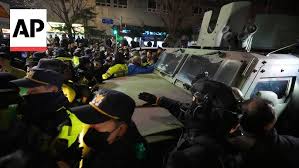
The December 3 military coup orchestrated by Yoon Seok-yeol, which abruptly froze our normal lives, has been thwarted for now. This was due to the swift actions of the Korean Confederation of Trade Unions (KCTU) on the front line, together with the courageous workers and citizens who rushed to the National Assembly to confront the martial law forces. They stopped heavily armored vehicles equipped with machine guns with their bare hands and engaged in physical confrontation with special forces armed with firearms and various lethal equipment. These heroic actions eventually created a situation of overwhelming resistance, leading to the National Assembly’s resolution to lift the emergency martial law.
Sweeping away the embers of conspiracy and the forces that support it
However, the flames of the rebellion have not been fully extinguished. While some key perpetrators of the rebellion have been arrested, its ringleader, Yoon Seok-yeol, still holds his position in the presidential office. Many of the rebellion’s masterminds, participants, and accomplices remain in their positions within the military leadership, cabinet, prosecution, police, and the Corruption Investigation Office. Furthermore, reports (MBC, December 24) indicate that dozens of special agents mobilized for the coup have not been disarmed and have yet to return to their bases.
To prevent a recurrence of the coup and ensure the peace of our society, those who participated in the rebellion using brutal weaponry must be strictly punished. Even Cho Gab-je, former editor-in-chief of Monthly Chosun and a mentor of the far right, has declared, “The highest leader must receive the maximum penalty to prevent this from happening again.” This task is clear.
However, some are resisting the effort to fully uncover and punish the details of the coup. Some are passively delaying the process and trying to complicate matters by nitpicking. Others are actively obstructing the punishment of coup participants by claiming that the loyalist coup was a “legitimate act of governance.” A prime example is the People Power Party, a far-right party rooted in the extreme regional divisions exploited as a tool of governance since the Park Chung-hee regime.
The Energy of the Pro-Democracy Protesters
This is why we cannot be optimistic about the situation. This is why we must take to the protest sites. In the 20 days since the coup, the number of protesters demanding punishment for the rebellion’s perpetrators has already exceeded several million. Protesters are braving severe cold, with temperatures plunging to minus 10 degrees Celsius, to participate in rallies. On the 22nd, they even stayed up all night in Namtaeryeong, where biting winds cut through the skin, standing in solidarity with farmer protestors who came on tractors.
The political atmosphere is tense and solemn, but the protesters are bright and full of energy. The protests, dominated by participants in their teens to thirties, are brimming with energy. They are sometimes solemn but generally optimistic. K-pop, protest songs, candles, and fandom light sticks come together in harmony, uniting as one. Most of the protesters were ordinary working people living their daily lives before the coup. Participants who enjoyed labor, leisure, hobbies of “idol fanning, games, etc.” and socializing were shocked by the crazy coup. They were outraged at how martial law suppressed their rainbow-colored daily lives with the dull gray of steel. They gathered in the streets to protect their way of life. Ordinary people have temporarily set aside their leisure to courageously confront the brutal violence threatening social peace.

This energy will not be broken. When the overwhelming majority of society gathers with this resolve, the fight will never be lost. Even those foolish ones will come to understand this.
Those Who Seek to Tame the Current of Democracy
They seek to slow the current. Their aim is to tame the political current. A strong current could strip away the surface and reveal the true causes of societal suffering. It might even reach the heart of power and wealth, long deemed untouchable. Their mission, therefore, is to tame the current, delay it, and drain its energy. Their goal is to extend the course of the current and channel it into a path of their choosing for control. This was how the massive candlelight protests of 2016–17 were eventually tamed by the March impeachment.
“We cannot oppose the direction of punishing the treasonous criminals, including Yoon Suk-yeol, but let us minimize and narrow the scope and severity of the punishment, to prepare for the future and protect our power and wealth intact.” This reflects the mindset of the coup participants, accomplices, and sympathizers.
Currently, Prime Minister Han Duck-soo appears to be at the forefront. After Yoon Suk-yeol’s impeachment was passed in the National Assembly, Han, serving as Acting President, has been delaying the procedures to hold coup leaders accountable. The far-right “People Power Party” (PPP) from Yeongnam is shielding him.

The Role of the United States
It is not only the People Power Party that seeks to tame the current using Han Duck-soo. The United States is also involved. Kurt Campbell, Deputy Secretary of State, stated at an Asia-Pacific press briefing in Washington, D.C., on the 19th, “We support the transitional role of Acting President and Prime Minister Han Duck-soo.” U.S. President Joe Biden also reportedly told Acting President Han in a phone call on the 15th, “I know you very well and trust you completely.” (Chosun Ilbo, December 21, 2024).
This intention was soon communicated to the Korean political sphere. U.S. Ambassador Goldberg met with Democratic Party leader Lee Jae-myung and People Power Party leader Kweon Seong-dong on the 23rd to deliver the message. Ambassador Goldberg stated, “The shared goals of the U.S. and South Korea will be prioritized in collaboration with Acting President and Prime Minister Han Duck-soo and the Korean government.” This statement came as efforts were underway to impeach the Acting President. Sitting meekly like a classroom monitor summoned to the teacher’s office, Lee Jae-myung bowed his head, stating, “Not only will South Korea-U.S. relations continue, but also cooperation among South Korea, the U.S., and Japan.”
Thus, the current slowed as if brakes were applied. On the 24th, the Democratic Party, which had declared, “The investigation into the coup cannot be compromised. Acting President Han’s remarks are aimed at prolonging the coup. We will immediately begin impeachment procedures against him,” changed its stance, stating, “We have decided to be patient and see whether the appointment of Constitutional Court judges on the 26th and our demands are fulfilled, keeping in mind the people’s sentiments.” Whose sentiments did the Democratic Party consider? While unclear whose hearts they kept in mind, it is certain that the U.S. and the People Power Party are intent on slowing the current.
Where Is the Democratic Party Headed?
The Democratic Party is caught between two opposing forces in the aftermath of the December 3 coup. On the left, there is pressure from tens or hundreds of thousands of citizens and laboring people who demand the punishment of Yoon Suk-yeol and other coup participants while defending the National Assembly’s resolution to revoke martial law. On the right, there is pressure from U.S. imperialism, which holds hegemony over South Korea’s capitalist system, along with local capital and its far-right proxy, the People Power Party (PPP).
On December 16, the Democratic Party hesitated, stating, “We will not pursue impeachment of Prime Minister Han. Let us establish a National Stability Consultative Body.” However, it has thus far been pushed largely by the strong pressure from the left to move in the direction of “repelling the coup and defending democracy.”
However, the expansion of democracy ultimately threatens the dictatorship of capital. Thus, the Democratic Party will eventually halt the democratic struggle. It will betray the cause of democracy.
On December 27, at 4:30 p.m., the Democratic Party passed the impeachment of Acting President Han Duck-soo. This was a result of yielding to the pressure of millions of protesters. With this, the struggle to repel the December 3 coup has advanced one step further.
At the Top of the Food Chain: U.S. Imperialism
The relationship between South Korea and the United States is not equal; it is hierarchical. The U.S. defeated Japan during World War II, a war of imperialist rivalry, and became the ruler of southern Korea. With its role and influence in South Korea’s economy, the establishment and control of the military, the networks of political elites, and cultural dominance centered on English, imperialist America sits at the apex of South Korean society’s food chain.
The U.S. extracts enormous surplus profits from South Korea, as vividly demonstrated during the 1997 IMF crisis. Furthermore, South Korea serves as a frontline against Russia (formerly the Soviet Union), North Korea, and China. Along with Japan and Taiwan, it is a strategic stronghold for U.S. imperialism. Pyeongtaek hosts the largest U.S. military base in the world, and the commander of U.S. Forces Korea also serves as the commander of the Korea-U.S. Combined Forces Command, holding military operational authority. Through various channels such as the embassy, the CIA, and NGOs, the U.S. maintains a dense network of relationships, collecting real-time information. With this power, it exerts decisive influence not only in the economy and military but also in politics, education, media, and culture.
Did the U.S. Not Know About the Martial Law Conspiracy and Execution?
The U.S. claims to have had no involvement in the December 3rd martial law declared by Yoon Seok-yeol and his faction, saying they only became aware of the incident after it occurred. This is a hard claim to believe. The highest command of the South Korean military is the Combined Forces Command, and the U.S. holds the wartime operational command through it, overseeing the Army, Navy, and Air Force. Through its embassy and the CIA, the U.S. also gathers information from South Korea’s intelligence agencies and political circles. It is even said that the U.S. conducts surveillance on key institutions, including the Presidential Office. Moreover, this martial law was planned a year in advance, with the conspirators aligning their intentions. At least four months prior, there were warnings about the coup conspiracy within the political sphere. Furthermore, this coup was not limited to a few units—known participants included the Defense Security Command, the National Intelligence Service, the Defense Security Command, Special Warfare Command, along with their subordinate units like the 707th Special Mission Group, Airborne units, and Tank units, all of which were involved extensively.

But did the U.S. not know? Are we to believe that this plan was hidden for nearly a year, avoiding detection from the U.S.’s extensive networks and information channels? And that this was done by ignorant fools relying on superstitions? We find it hard to accept this.
We believe that the relationship with the U.S. must be included in the investigation into the coup and insurrection. Did the U.S. truly not know? How could they not know? If they knew in advance, why did they not stop it? Could they have been involved in the conspiracy, or perhaps knowing the plans, did they just let it unfold, turning a blind eye? This must be clarified. This is a crucial task in identifying the origins of the current situation and preventing future recurrence. After all, the U.S. has historically been involved in military coups in colonies, including those by Park Chung-hee and Chun Doo-hwan, since the U.S. gained global hegemonic power.
―Let the working class take the lead and immediately remove and punish the insurrectionist leader Yoon Seok-yeol and his faction!
―Even if we cook a meal and let the dog eat it again, oust Yoon Suk-yeol!
―Politicians, including those in the Democratic Party, are not the solution to the problem, but merely another set of responsible figures alternating roles. Let’s reject any illusions about capitalist politicians!
―Let’s be wary of the brake that the Democratic Party is putting on the flow of democracy!
―The U.S. must clearly clarify whether it knew about the December 3rd coup in advance!
―The root of the problem is ultimately capitalism. Let’s establish a workers’ government!
December 27th 2024
Bolshevik Group
 Class Conscious