by Karin Hilpisch, 17th September, 2023
In an article titled, New York City Subway Killing – Neely No Angel, Penny No Hero (1), the International Communist League (Fourth Internationalist) comments on the killing of a black man in a subway at the hands of a white male former Marine.
The ICL contests the notion of “any physical confrontation involving a white man defending himself against a black man as automatically driven by racism.”
It is a well-known phenomenon that a victim-perpetrator-dynamic gets redefined — and thus ideologically dissolved — as one in which the perpetrator is defending him- or herself against the victim. Kyle Rittenhouse, for example, successfully claimed self-defense against two unarmed men he shot. Jordan Neely’s killer, Daniel Penny, used no gun but a method of bare-handed lethal force, acquired in military training, against an unarmed civilian. The deadly outcome of keeping someone in choke-hold until he passes out is foreseeable, not an accident.
Against what exactly was Penny defending himself and the other passengers on the subway? To answer this question, I’d suggest we first look at the power relations between the persons involved.
The ICL observes that Neely was homeless and “schizophrenic.” It refers to a person suffering from a clinically relevant degree of mental distress in highly pejorative terms, that is, as “mentally unhinged” and “mentally deranged.”Such vocabulary — madness is the most common word used in this context — reveals an extremely reactionary stereotype of people with a psychiatric record.
I argue that “mental illness” is mental injury, that is, mental trauma, inflicted in social power relations, first and foremost in the nuclear family, the primary institution of mystified power imbalance. People with psychiatric diagnoses suffer from the long-term effects of childhood trauma — physical, sexualized and/or emotional abuse — at the hands of parents or other caregivers whom as children they were totally dependent on. Trauma sequelae labeled “schizophrenia,” in particular, are a potential outcome of the mystification and alienation characteristic of the family, whereby it performs its main social function for capitalism, that of instilling obedience to authority (its economic function being to minimize the costs of reproducing labour power).
My view of schizophrenia is informed by the seminal works of R.D. Laing, David Cooper, and Aron Esterson (2). Key to an understanding of how family communication drives children “mad” is the body of work of the Palo Alto Group of the Mental Research Institute (3). The neurophysiology, or psycho-physiology, of trauma is being researched in more recent subject literature. (4)
Having poor “mental health” thus means being the victim not of misfortune but of injustice. The injustice is systemic because trauma survivors are being stigmatized in all areas of society, and are routinely denied access to proper therapy. The paradigmatic pathologizing of clinical mental injuries as conditions more or less stemming from genetic/neuro-biological abnormalities functions to mask their social origin.
The anti-materialist concept of psycho-pathology insulates psychic experience from the social reality to which it is a response. What distinguishes “mental illness” from other illnesses is that this concept carries the mythology of moral degeneracy, which means something qualitatively different from being a bad person. The person classified as mentally ill is regarded as a being who has psychic experiences which are not related to his or her social reality. He or she is regarded as human-like but not as a human being. [1]
That is the very meaning of stigma; stigmatized people are seen as less than human. Its characteristic feature is victim-blaming: the schizophrenic’s family may have treated him like shit — but something must have been wrong with him from the outset, right?. Women are subjected to sexualized violence — but isn’t there something inherently ambiguous about rape, at least if the rapist is the woman’s (former) lover? Relatively more black than white people are subjected to police violence — but perhaps they provoke it, at least some of the time?
Thus stigma makes injustice invisible. And stigmatization in all its forms serves the immobilization of class struggle.
The unwitting irony of the ICL’s labeling Neely’s behaviour on the train “unhinged, “deranged,” and “crazed,” i.e., portraying it as unintelligible, is that precisely the opposite is true. Following various sources, Neely had been crying out that he had no food, no drink, that he was tired; that he didn’t care if he went to jail; that he was ready to die. So he was talking about being hungry, that he needed something to eat, and he was so driven to distraction by his predicament on the street that he said he’d rather go to jail for life — given the context of his life, those statements made perfect sense.
“Crime and crazed outbursts are concerns that working people who ride the subway face every day.”
One might be forgiven for getting the impression that the ICL is engaging in fear-mongering about degenerate hordes roaming the subways, from which orderly workers have the right to protect themselves at all costs, even if that involves cheerleading for a Marine using lethal violence. To the extent that working class people support this vigilantism, which is based on an individualizing, moralizing perspective on social predicaments, this lack of sensitivity is the result of the reactionary narrative the ICL is peddling, thus driving a wedge between majority workers and the most oppressed minorities.
“When the case first hit the news, many working people—black, white and Latino—were sympathetic to Penny,” and that “of “the two men who helped Penny restrain Neely …one ..was either black or Latino.”
These circumstances the ICL takes to disprove “the narrative that Neely was the victim of a race-fueled crime…” This logic doesn’t hold water, however. What makes a crime objectively racist is not the ‘racial’ classification of the perpetrator but the victim’s structurally enhanced vulnerability, as a member of a racialized social group, to being targeted, relative to other social groups. If in any given community the ratio of non-white and white citizens is, say, 1:10, and the ratio of non-white and white victims of violence is 2:10 — and it tends to be much higher — this shows the violence targeting non-white people to be racist.
According to the ICL, Neely “acted in a threatening manner and was said to have thrown trash at passengers. (…) In the eyes of the passengers that day, Neely was a real-life threat.”
It takes a Marxist to wonder whether, and to what extent, the passengers’ sense of being threatened may have been informed by Neely’s having being subject to stigmatization as a black, homeless, and “mentally ill” person. Such considerations are obviously alien to the ICL which, at any rate, is not in contact with the social reality of Neely’s life — a peculiar blindness astounding for a Marxist organization, culminating in its observation that he was “no angel.” No angel — but someone who “did not deserve to die” (emphasis in original). Against the background of everything else the ICL says about him, this comes across like nothing more than a disclaimer.
As for speaking of Neely having been “restrained” to stop his “threatening a crazed assault on passengers,” isn’t the ultimate question, looked at without racist or other bias, did he pose a physical threat to anyone in the subway of a kind in response to which killing him could be seen as a necessary act of self-defense in any legally or morally meaningful sense of that word? From what I have read about it so far, I fail to see that that is the case. What Neely’s killer was in fact “defending” himself against was having to share the subway with a man he regarded as less than human.
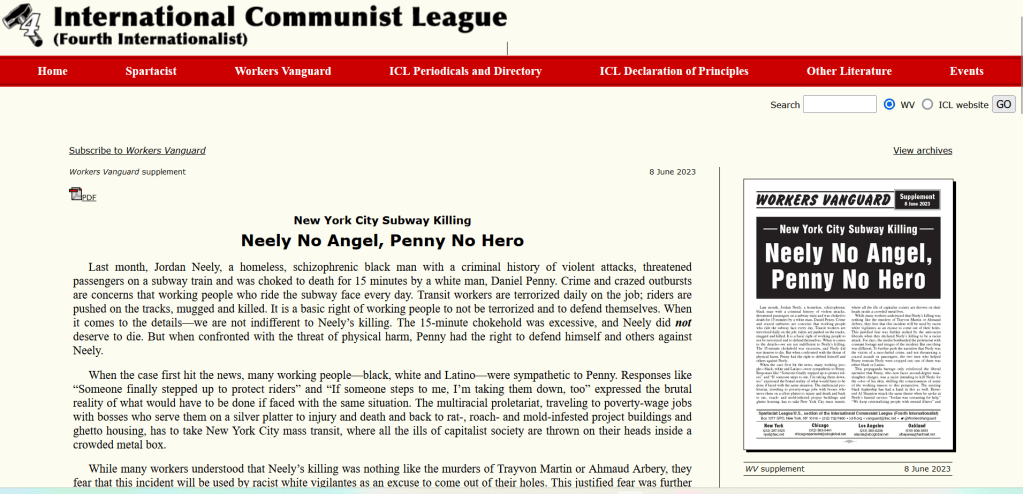
[1] All quotes above are taken from this publication.
(2) See, e.g.,
Laing, R.D. (1960) The Divided Self: An Existential Study in Sanity and Madness. Harmondsworth: Penguin.
Laing, R.D. and Esterson, A. (1964) Sanity, Madness and the Family. London: Penguin Books.
Laing, R.D. (1971) The Politics of the Family and Other Essays. London: Tavistock Publications.
(3) See, e.g.,
Jackson, D. (Ed.). (1968). Communication, family and marriage (Human communication, volume 1). Palo Alto, CA: Science & Behavior Books.
Jackson, D. (Ed.). (1968). Therapy, communication and change (Human communication, volume 2). Palo Alto, CA: Science & Behavior Books.
(4) See, e.g.,
Levine, Peter A. (1997). Waking the Tiger: Healing Trauma: The Innate Capacity to Transform Overwhelming Experiences: North Atlantic Books.
 Class Conscious